01 Setting up your vault
The first launch does one thing: it creates the encrypted vault that everything else lives in. There is no account to register and no email address to hand over.
- Open the app and tap through to Create your secure vault.
- Type a master password of at least 9 characters, then type it again to confirm. Tap Show if you want to check what you typed.
- Tap Create vault. Your vault is generated and encrypted on the spot.
- You will be offered an emergency recovery key. Create one now if you can — it is the only way back in if you forget your master password. If you would rather do it later, tap Not now and set it up from Settings whenever you are ready.
Your master password is never stored anywhere — not on your phone, not on a server, not in any form we could read. That is what makes the vault private, and it also means nobody can reset it for you. Pick something you will genuinely remember, create the recovery key, and keep an exported backup somewhere safe. The app makes all three easy.
Choosing a good master password
- Longer beats complicated — four or five unrelated words are strong and memorable.
- Do not reuse a password you already use somewhere else.
- Do not use anything guessable from your social media — pet names, birthdays, kids.
- Write it down and keep the paper somewhere only you can reach, if that helps you.
02 Unlocking day to day
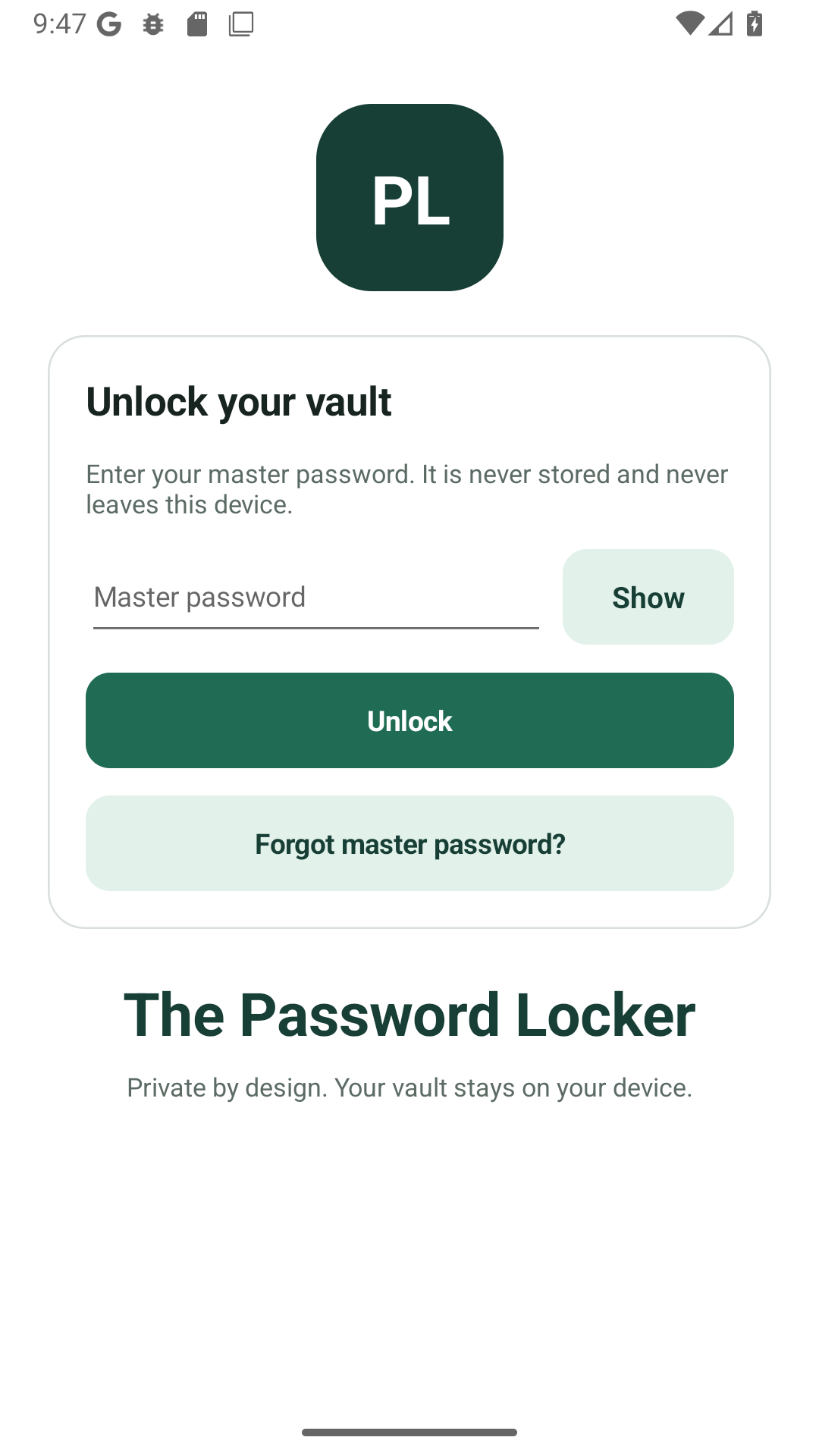
After setup, every launch starts here. Type your master password and tap Unlock — or use a fingerprint or face if you have turned that on.
Master password
Always works. Tap Show to reveal what you are typing if a character went astray.
Biometric quick unlock
Optional and off by default. Turn it on in Settings once your vault exists.
Forgot master password?
The link on the unlock screen starts recovery using the emergency recovery key you saved.
Once you are in, four tabs run along the bottom of the screen and stay there: Folders, Search, Settings and About.
03 Folders
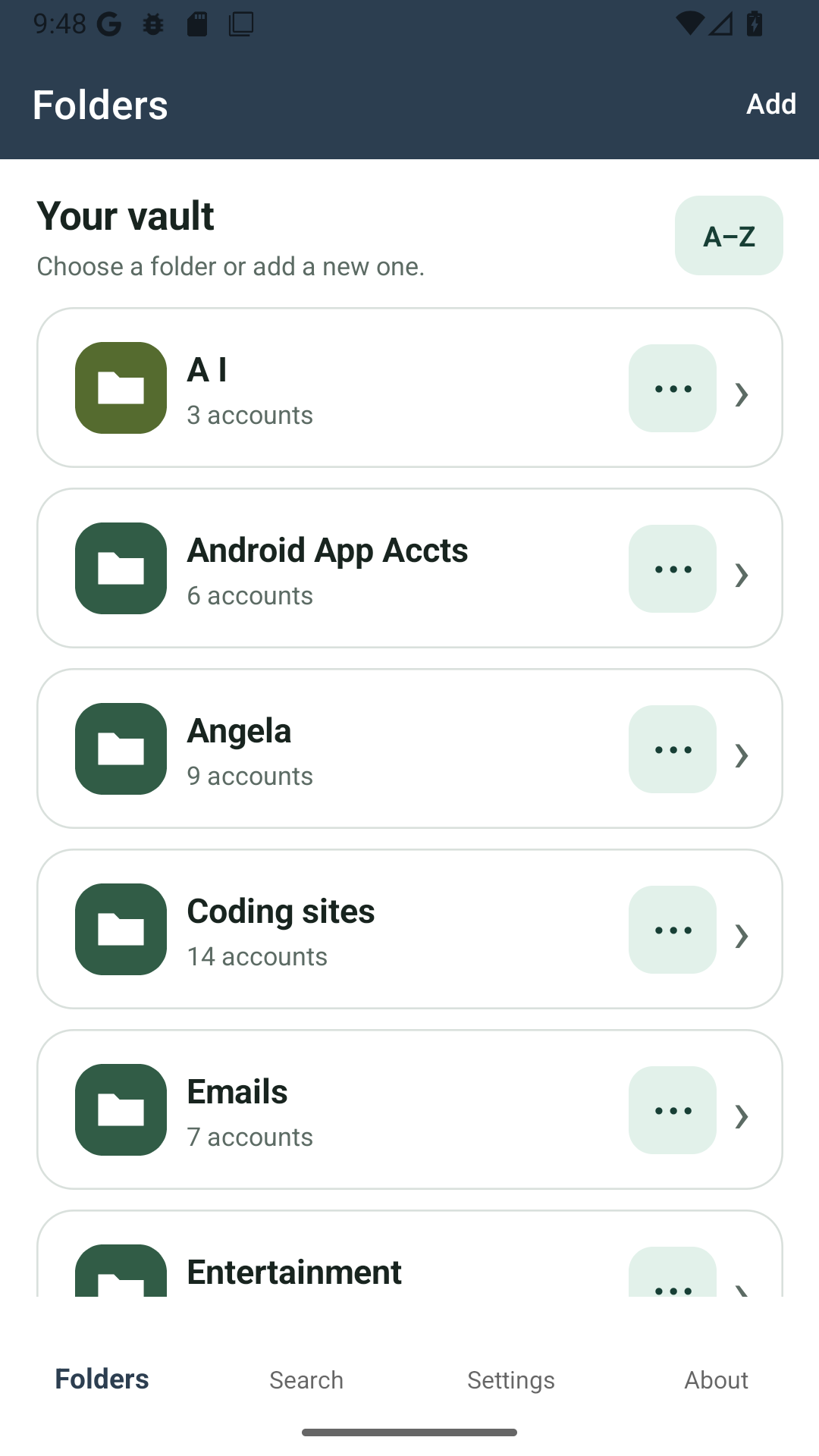
Folders are how you keep a few hundred accounts from turning into a wall of text. Group them however your life is actually organized — by person, by purpose, by whatever makes sense to you.
Create a folder
- On the Folders tab, tap Add in the top right.
- Give the folder a name.
- Save it. It appears in the list with a running count of the accounts inside.
Rename, recolor or delete
Tap the … button on any folder row to open its menu. The chevron on the right opens the folder instead.
Sorting
The A–Z button at the top right of the list toggles the folder order, so you can flip between alphabetical and your own arrangement.
Broad folders beat clever ones. Email, Banking, Shopping, Work and a folder per family member will cover almost everything, and Search finds anything you misfile anyway.
04 Accounts in a folder
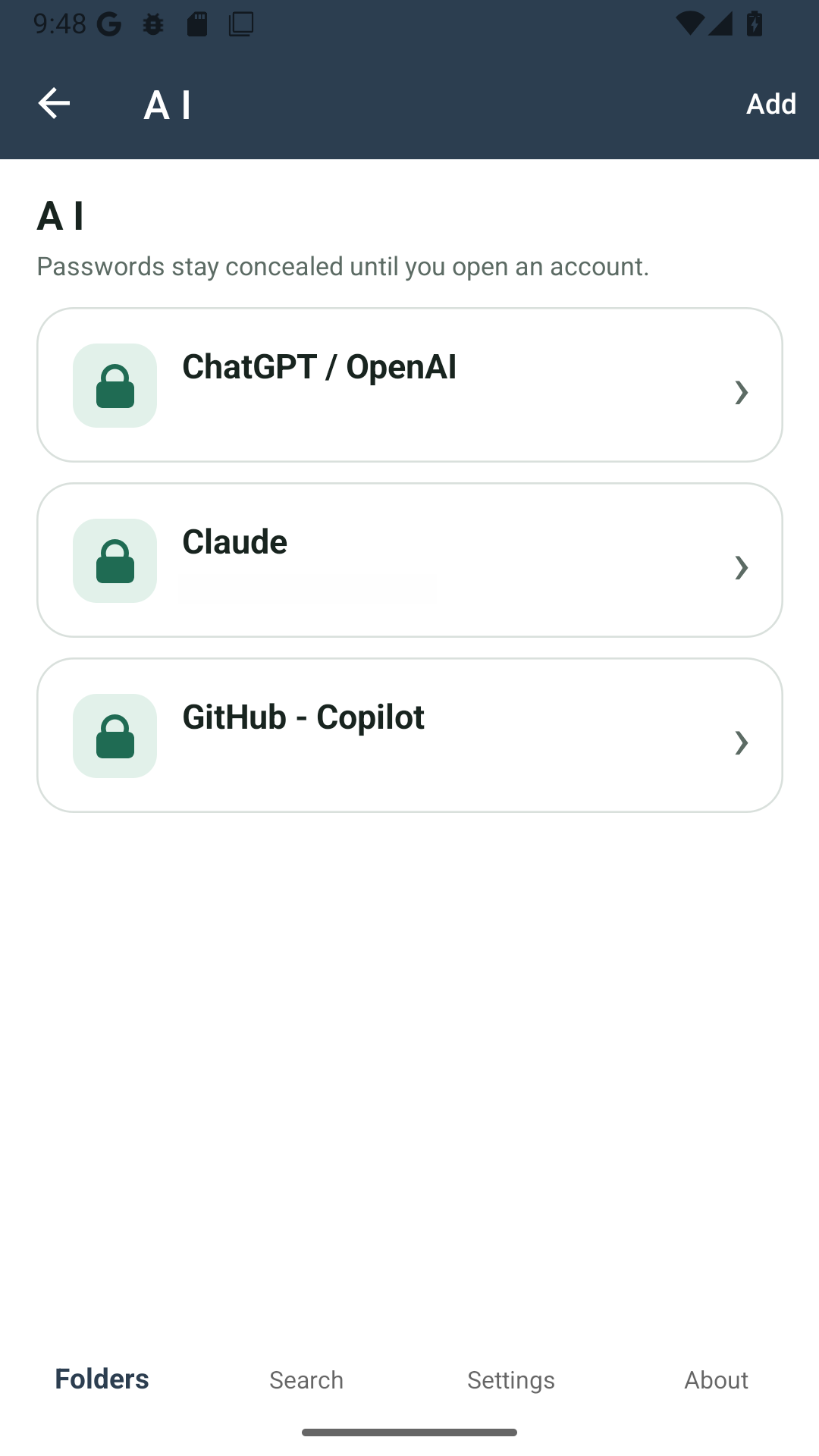
Open a folder and you get its accounts. Passwords stay concealed in this list — nothing sensitive is on screen until you deliberately open an entry.
- Tap a folder to open it. Its name sits in the title bar so you always know where you are.
- Tap Add in the top right to create a new account entry.
- Tap any existing row to open it for viewing or editing.
- Use the back arrow in the top left to return to your folder list.
Every account you create belongs to exactly one folder, and you can move it to a different folder later by changing the Folder field on the account screen.
05 The account screen
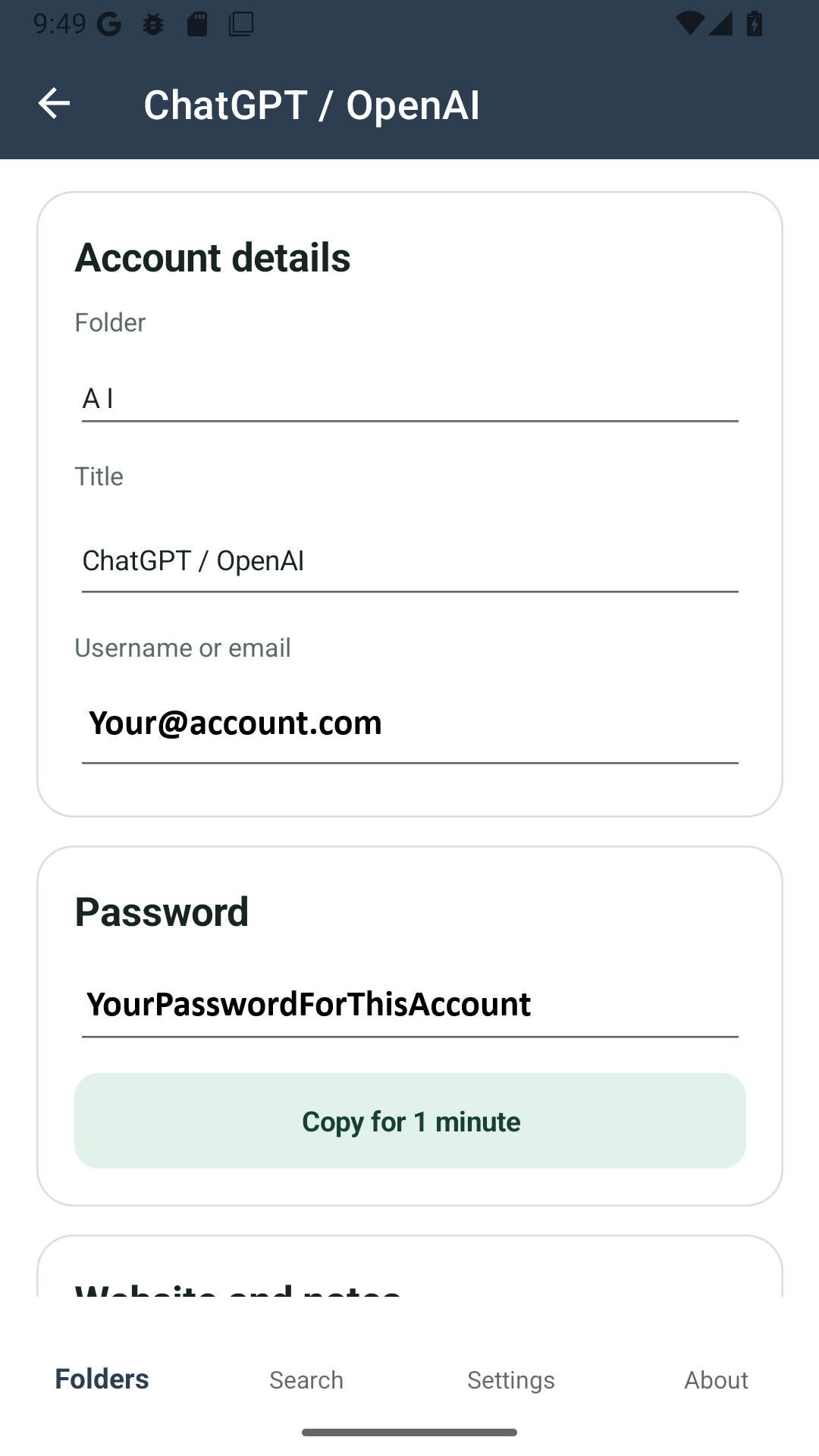
One screen holds everything about a login: where it belongs, what it is, how you sign in, and anything else you want to remember about it.
Account details
- Folder — which folder this entry lives in. Change it here to move the account.
- Title — what you will recognize it by in lists and search results.
- Username or email — whatever you actually sign in with.
Password
Type or paste the password for this account. Tap Copy for 1 minute to put it on the clipboard — the app clears it automatically after sixty seconds, so it is not left sitting there for the next app that goes looking.
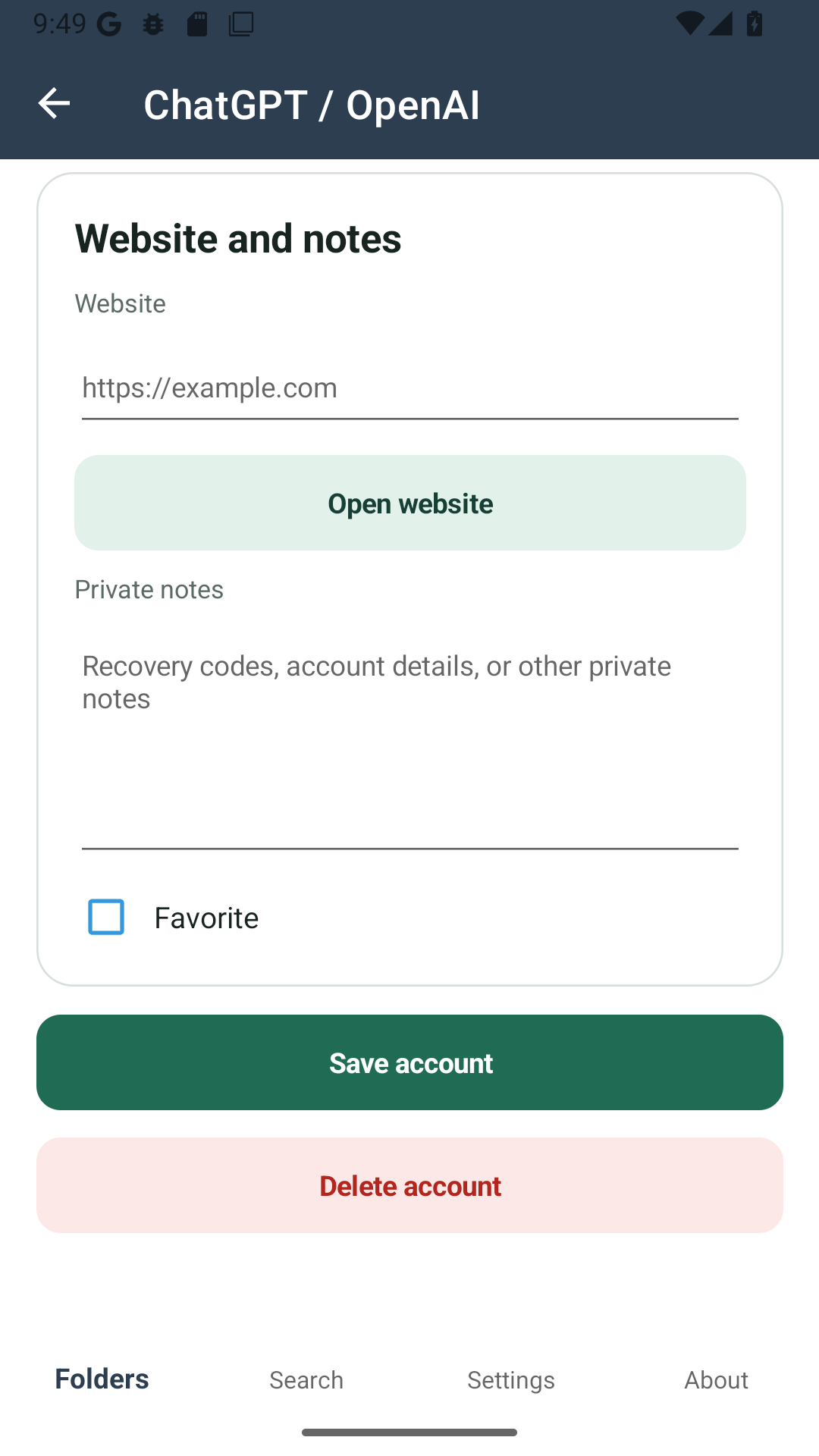
Website and notes
- Website — the sign-in page for this account. Open website hands the address to your browser; the app itself has no internet access.
- Private notes — a free text area for recovery codes, security question answers, account numbers, or anything else worth keeping with the login.
- Favorite — tick it to mark the entries you reach for most often.
Saving and deleting
Save account writes the entry back to the vault, encrypted. Delete account removes it. Deleting is permanent for the live vault — though an entry deleted today will still exist inside yesterday's daily backup.
06 Notes are not just for logins
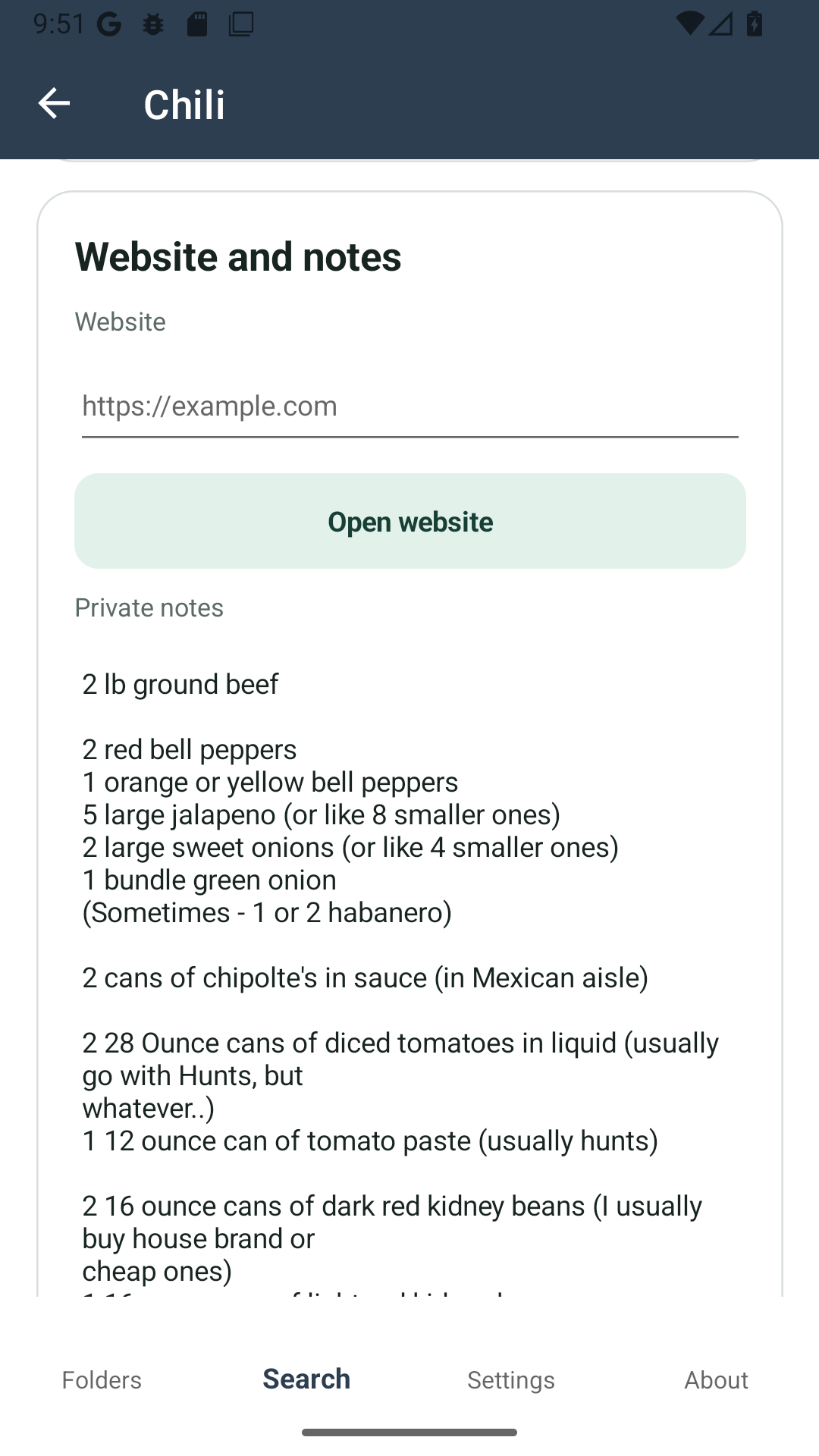
The private notes field is ordinary encrypted text, and it does not care what you put in it. Plenty of people use it for things that have nothing to do with passwords.
Anything you would rather not leave in a plain notes app fits here — and it gets the same AES-256-GCM encryption as every password in the vault:
- Two-factor recovery codes and backup codes
- Wi-Fi passwords, alarm codes, garage and locker combinations
- Software licence keys and serial numbers
- Membership, insurance and frequent-flyer numbers
- Family recipes you do not want to lose — genuinely, why not
Give the entry a clear Title, leave the password field empty if there is no password, and Search will find it later by title or by anything inside the note.
07 Search
Once a vault has real content in it, search is faster than remembering which folder you filed something under.
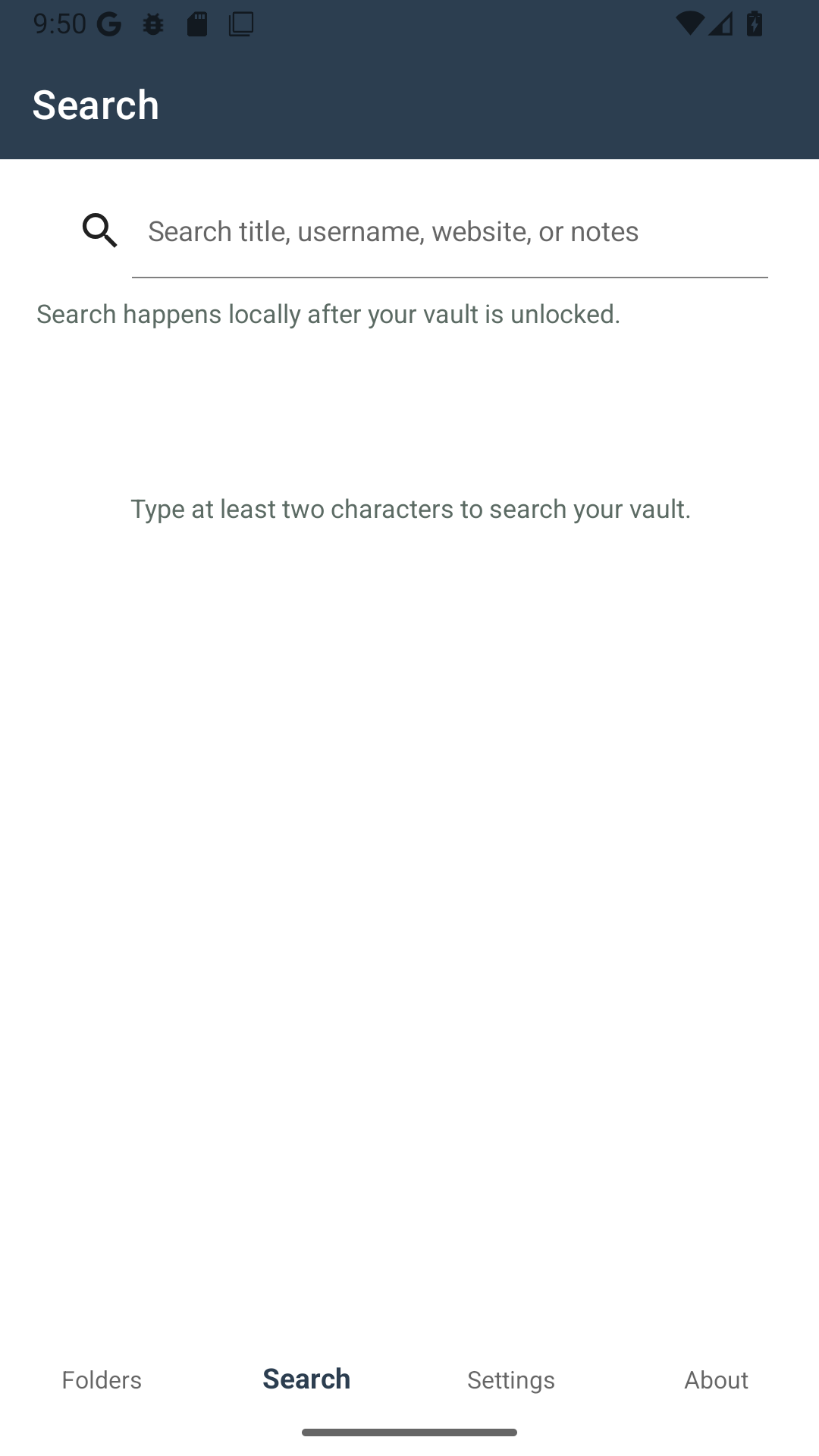
- Tap the Search tab.
- Type at least two characters.
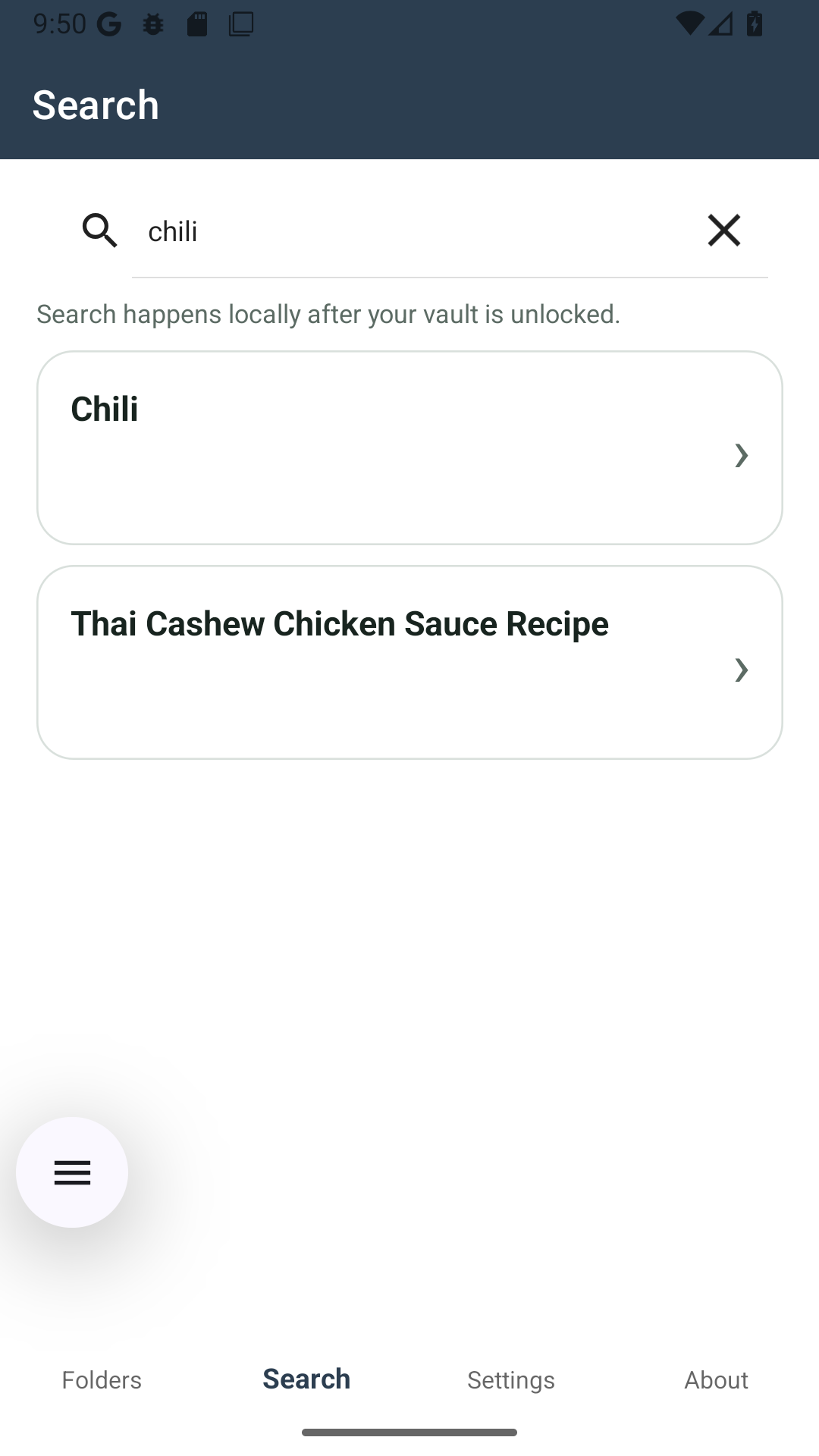
- Results appear as you type, across every folder at once. Tap one to open it.
What gets searched
Search looks at the title, the username or email, the website, and the text of your private notes. Passwords themselves are never searched and never appear in results.
Search runs locally against the vault after it has been unlocked. Nothing you type into the search box is sent anywhere — there is nowhere for it to go.
08 Lock, biometrics & recovery
The top of the Settings tab is where you decide how tightly the vault holds itself shut, and how you get back in if the worst happens.
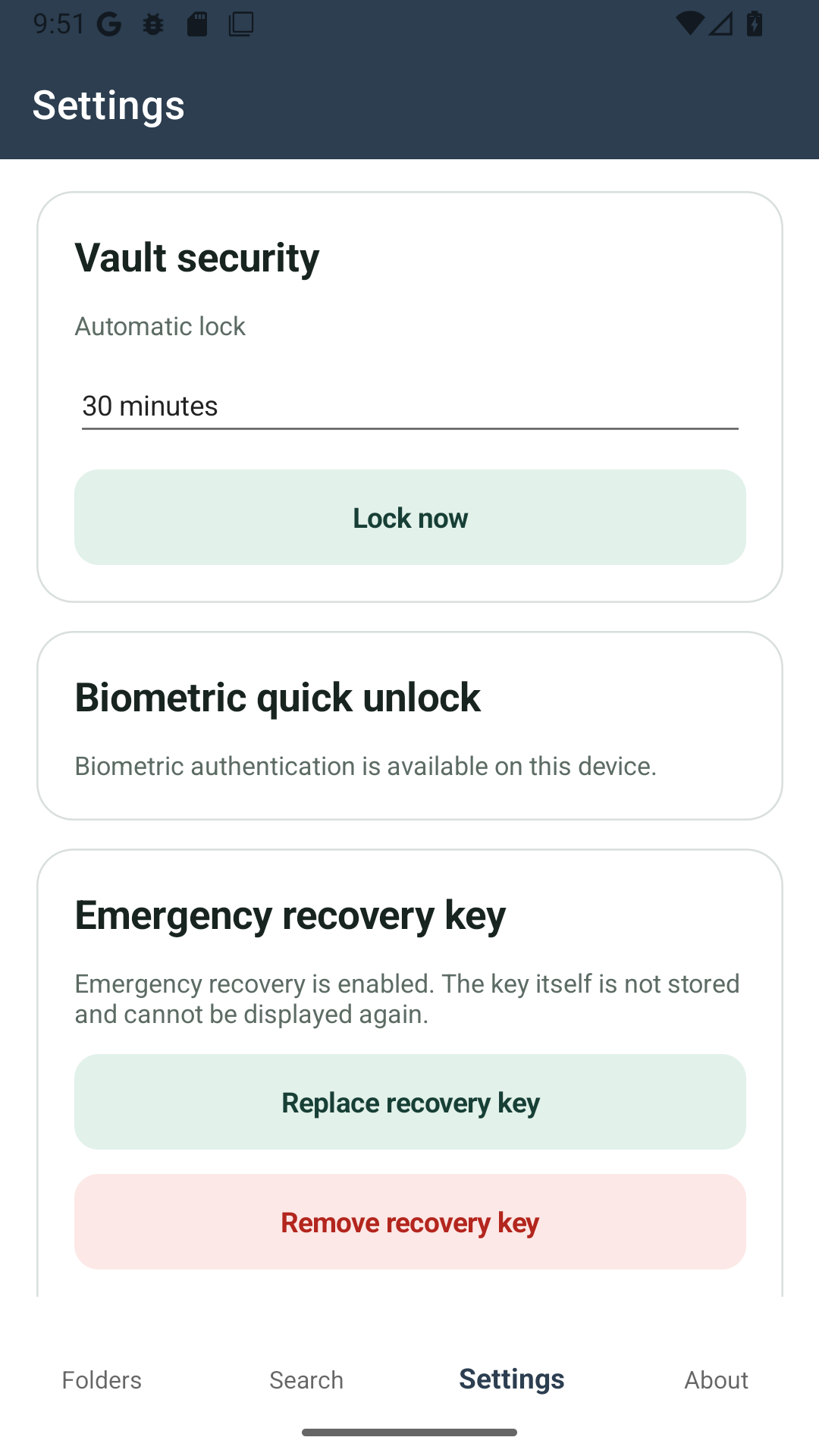
Automatic lock
Choose how long the vault stays unlocked while you are not using it. When the timer runs out the vault locks itself and the key is wiped from memory. Lock now does it immediately — useful when you are handing your phone to somebody.
Biometric quick unlock
If your phone supports a fingerprint or face unlock, you can use it instead of retyping your master password. It is optional and off until you turn it on, and your master password always continues to work.
Emergency recovery key
The recovery key is your safety net for a forgotten master password. Create it, then store it somewhere away from your phone — a password-protected file on a computer, a printed copy in a drawer, a safe.
- Replace recovery key generates a fresh one and retires the old one.
- Remove recovery key turns emergency recovery off entirely.
The recovery key itself is not stored by the app and cannot be displayed again. Capture it at the moment it is created. If you lose it, generate a replacement while you still have access to your vault.
09 Backups & restore
Because nothing is kept on a server, backups are the thing standing between you and a lost phone. The app handles one kind for you and gives you a second kind to look after yourself.
Automatic daily backups
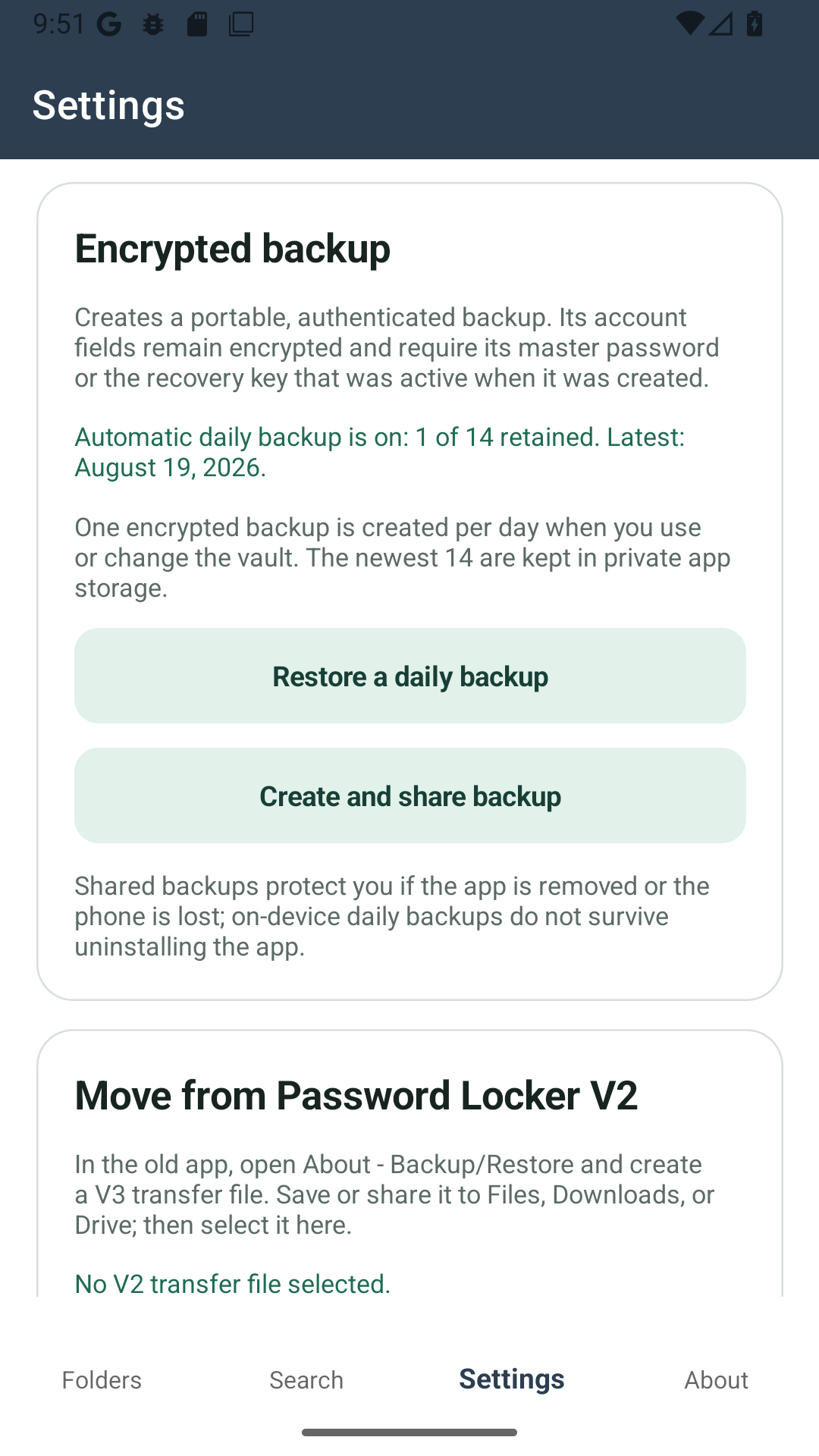
One encrypted backup is created per day on any day you use or change the vault. The newest 14 are kept in the app's private storage, and Settings tells you how many exist and how recent the latest one is. Restore a daily backup rolls the vault back to one of them.
Portable encrypted backup
Create and share backup produces a portable, authenticated backup file you can send wherever you like — another device, a drive, cloud storage, an email to yourself. Its account fields stay encrypted the whole time and it still needs the master password (or the recovery key that was active when it was made) to open.
Daily backups live inside the app, so they do not survive uninstalling it and they go down with a lost or broken phone. A shared backup is the only copy that survives either. Make one now, and again after any big change to your vault.
Restoring
- Install the app and create a vault, or unlock your existing one.
- Go to Settings and choose the backup you want — a daily one, or a file you saved.
- Supply the master password (or recovery key) that was in force when that backup was created.
10 Moving from Password Locker V2
Already using the previous version? Your vault comes across in a few taps, and the original is never touched.
- In the old app, open About → Backup/Restore and create a V3 transfer file.
- Save or share that file somewhere the new app can reach it — Files, Downloads, or Drive all work.
- In the new app, go to Settings → Move from Password Locker V2 and select the transfer file.
- Enter the master password that protected the old vault, and let the import finish.
- Check that your folders and accounts arrived, then keep the old app installed for a few days just in case.
The import copies your data. Your original V2 vault is left exactly where it was, and a dated safety copy is made before anything is written. If the import is not what you expected, the old app still opens and still works.
11 How your vault is protected
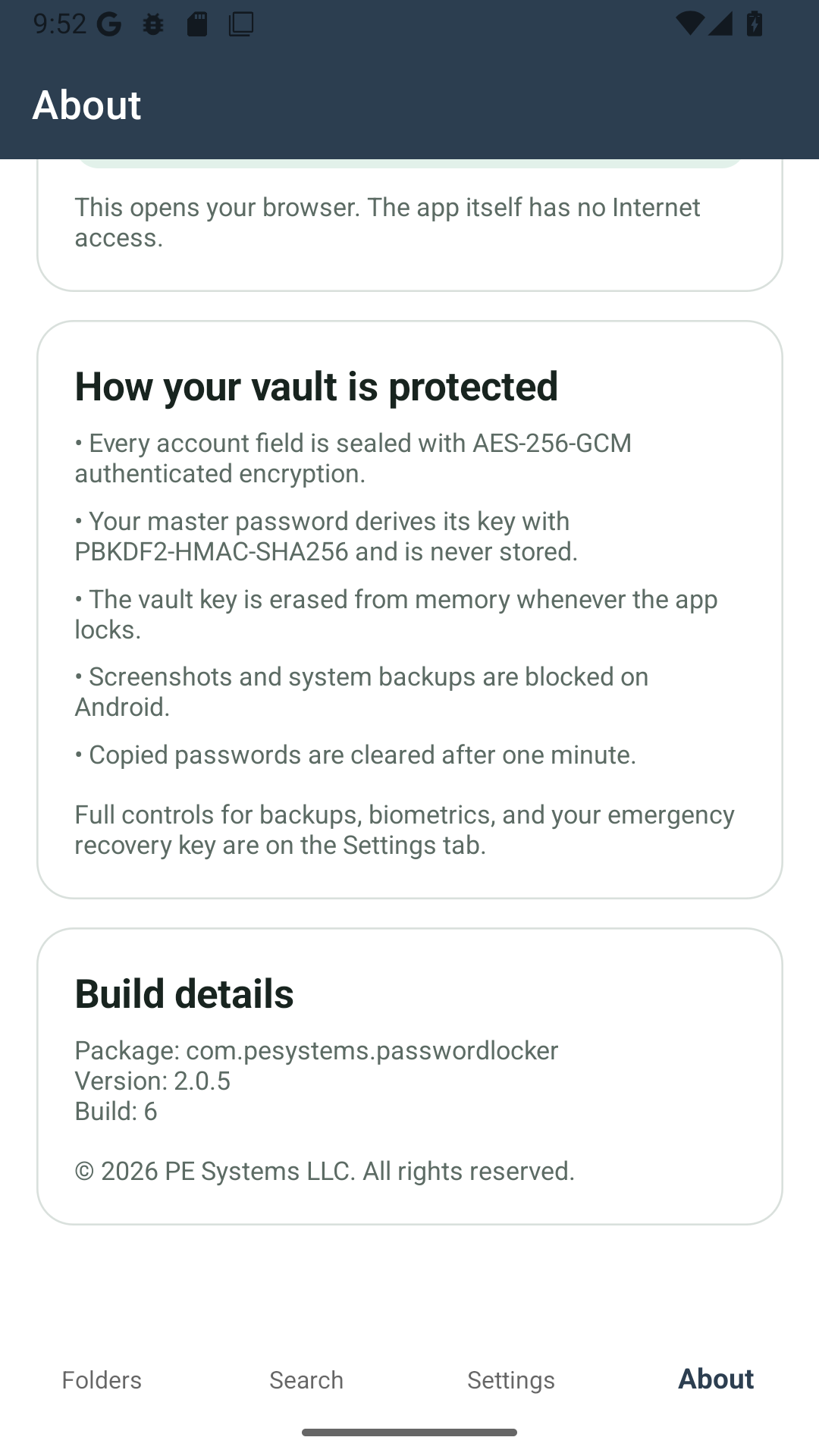
The privacy claims on this app are structural, not promises. Here is what is actually happening underneath — the same summary you will find on the About tab.
AES-256-GCM
Every account field is sealed with authenticated encryption. Tampered or corrupted data is detected and rejected, never quietly accepted.
PBKDF2-HMAC-SHA256
Your master password derives the vault key at 600,000 iterations with a unique random salt. The password itself is never stored.
Key wiped on lock
The vault key is erased from memory the moment the app locks — on the timer, on Lock now, or when you leave.
No internet permission
The app is built without Android's INTERNET permission. It is not that it will not send your data anywhere; it cannot.
Screenshots blocked
Android is told to refuse screenshots and screen recording of the app, and system cloud backup of app data is switched off.
Clipboard clears itself
A copied password is wiped from the clipboard after one minute without you having to remember.
No accounts, no registration, no analytics, no advertising, no third-party SDKs. Uninstall the app and every trace of the vault goes with it. Full details are in the privacy policy.
12 Questions & troubleshooting
The things people ask most, answered plainly.
I forgot my master password. What now?
Tap Forgot master password? on the unlock screen and use your emergency recovery key to set a new one.
If you never created a recovery key, the vault cannot be opened — not by you and not by us. That is the direct consequence of your master password never being stored anywhere. If you can still get in right now, go to Settings and create a recovery key today.
Can PESystems recover my vault or reset my password?
No, and that is deliberate. We hold no copy of your vault, no copy of your master password, and no key material of any kind. There is no server to ask. In exchange, there is also nothing for anyone to breach, subpoena or leak.
I lost my phone. Are my passwords gone?
If you made a shared encrypted backup, no — install the app on the new phone and restore from that file using the master password that was active when it was created.
If your only backups were the automatic daily ones, they were stored inside the app on the old phone and are gone with it. This is the reason to create and share a backup now rather than later.
Does my vault sync between my phone and my tablet?
No. Syncing requires a server, and the app has no network access at all. To use the same data on a second device, create a shared encrypted backup on the first and restore it on the second. From that point the two vaults are independent and will drift apart as you edit them.
Why is my screenshot of the app completely black?
That is working as intended. The app asks Android to block screen capture and screen recording so that nothing else on your phone can photograph your passwords. It applies to you as well as to anything malicious, which is why the screenshot comes out blank.
How do I check the no-internet claim myself?
Open the Google Play listing and look at its permission list, or check App info → Permissions in Android settings. There is no network or internet permission there. The only permission the app requests is optional biometric unlock.
Open website on an account screen is not an exception — it hands the address to your browser and your browser does the fetching. The app never opens a connection.
The V2 transfer file will not import.
Work through these in order:
- Confirm the file was created by the old app as a V3 transfer file, not as a plain V2 backup.
- Enter the master password that protected the old vault, which may not be your new one.
- Make sure the file is somewhere the picker can actually reach — Downloads or Files rather than deep inside another app.
- Re-export it from the old app if it was ever opened, edited or renamed by another program in between.
Still stuck? Email support and describe where it stops.
I deleted an account entry by mistake.
Deleting is immediate in the live vault, but the entry still exists in any daily backup taken before the deletion. Go to Settings, restore a daily backup from before the mistake, and copy what you need. Note that restoring rolls back the whole vault, not one entry, so restore first and re-enter anything newer afterwards.
Is there a way to erase everything permanently?
Uninstall the app. The vault and its daily backups live in the app's private storage and are removed with it. Nothing is left behind on your phone and nothing was ever anywhere else. Any portable backup file you exported yourself is a separate copy — delete those too.
How much does it cost?
There is no subscription and no account. The app has no way to charge you for anything on an ongoing basis, because it has no way to talk to a server.
13 Support
Found a bug, hit something this page does not cover, or want to suggest a feature? Get in touch — a real person reads it.
Tell us your Android version and what you were doing when it went wrong.
Google Play
Install or update the app, check its permission list, and leave a review.
Privacy policy
What is collected, what is stored, and where. Spoiler: nothing, and on your phone.
More from PESystems
Custom software, web portals and real-time systems from Patrick Eckler.
We will never ask for your master password, your recovery key, or the contents of your vault — not by email, not by any other route. Nobody legitimate needs them, and we could not use them if you sent them. Anyone who asks is not us.